‘I Want My Own Home’: Trans Actor Jeeva on Finding Her Place in Tamil Cinema & Making It to Toronto
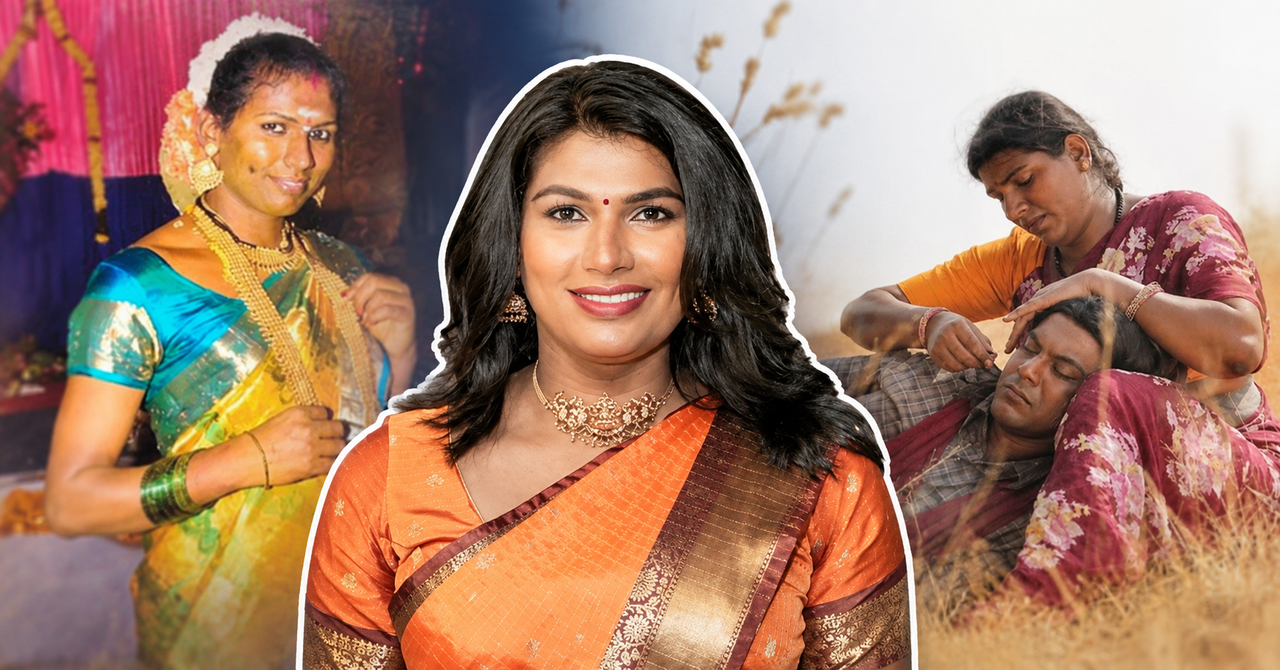
At 13, Jeeva Subramanian arrived in Chennai with Rs 300 her mother had given her. Her brother had accompanied her to the city, but left her at Koyambedu bus stand. Unfamiliar with the place and with nowhere else to go, she waited for him to return.
“I did not know anyone in Chennai. I thought my brother would come back to take me, so I kept waiting in the same place. I would go to the public toilet, wash myself and my clothes, and return to where I had been sitting. I kept thinking he would look for me there,” she recalls.
Two days passed before Jeeva realised that he was not coming back. By then, she had spent nearly three days at the bus stand. A woman who worked there cleaning the premises eventually approached her and offered to find her a job.
That conversation led to Jeeva’s first job in Chennai, at a shop inside the bus stand. She earned Rs 40 a day, with food and accommodation provided by the employer, though her wages were held back for seven days at a time.

“I was only 13. That was my first job in Chennai. They gave us food and a place to stay, so I continued working,” she says.
The job lasted about two months. When it ended, the bus stand became her refuge again. She slept within sight of a police booth because she felt safer there, and took up whatever work she could find, including carrying vegetables at the Koyambedu market in the early hours of the morning.
At the time, Jeeva knew she was a girl, but did not know what it meant to be transgender or that there was a community of people like her. “I lived with the feeling that I was a girl. I did not know there was a transgender community. I was a child. I did not understand what was happening around me,” she says.
From surviving to finding her place
Jeeva eventually found work clearing used banana leaves after wedding functions at a marriage hall. But workers were asked to leave once a wedding was over, and she was again left searching for somewhere safe to stay. A visitor at one of the functions gave her a contact for a housekeeping company. Through it, she found work at a sweets outlet in Vadapalani, earning Rs 2,200 a month, along with food and accommodation.
Around this period, Jeeva began to understand her identity and gradually encountered other transgender people. Dance offered another possibility.
She joined a dance school and began performing at programmes, sometimes wearing wigs for devotional and glamour songs. When the programmes stopped, she was once again left looking for work. A friend helped her find occasional performances, but that too came to an end when he moved to Dubai.

Her next opening came through cinema, where she began working as a touch-up assistant. She had already developed an interest in acting, but expressing that ambition was not easy. People questioned whether she was good-looking enough to act, and once they learnt she was transgender, some became reluctant to employ her.
“I used to tell people that I wanted to act, but they would ask me, ‘What are you going to do by acting? Are you beautiful enough?’ They would dismiss the idea. After they found out that I was trans, people became hesitant to take me for work. Some of the other assistants would keep teasing me,” she says.
There were, however, people who stood up for her. Actor Bala Singh, with whom she worked for several years, was particularly protective. Jeeva remembers him telling others, “She is my daughter. Why are you talking about her like that?” She also worked with actors including Anushka Shetty, Taapsee Pannu, Shriya, and Ramya Nambesan.
Actor Shriya encouraged her to learn makeup, a skill that could support her financially. Jeeva went on to work as a bridal makeup artist, doing makeup for around 400 brides. But discrimination followed her into this profession too, and a bad experience eventually forced her to give it up.

Even as she found ways to earn, the search for a stable home remained unresolved. The rooms she could afford were often in poor condition, with rainwater entering the house and collecting up to her knees. The 2015 Chennai floods damaged her home and left her with very little. A friend, Sheela, took her in and gave her food and shelter.
These experiences had already taught Jeeva how precarious everyday life could be. But it was on a film set that she encountered a moment of acceptance that would change how she saw her place in the industry.
The embrace that changed her relationship with cinema
By the time she was called to work on Dharma Durai, Jeeva was considering leaving Chennai. She had worked for years, tried different jobs and felt that none of it was taking her anywhere. She accepted the opportunity partly because she admired actor Radhika.
The shoot, however, was difficult. People in the crowd used slurs against her, and she found it hard to continue performing. She broke down and cried. Actor Vijay Sethupathi noticed what was happening, intervened, and asked the crowd to stop. He told them, “She is my younger sister,” before hugging Jeeva and kissing her forehead.
For someone who had experienced rejection and abuse, the gesture carried a meaning that went far beyond the film set.
“An embrace may be a normal thing for other people, but it did not come to me so easily. I cannot even put into words what I felt that day. When he hugged me, I closed my eyes for a moment, and it felt as though the whole universe was spinning around me. Nobody had hugged me like that before. He kissed me on the forehead, and I held on to him and cried,” she says.

Director Seenu Ramasamy then encouraged her to continue with the scene, telling her that the very people insulting her should one day whistle and applaud when they saw her on screen.
“He could have said that they should get someone else to do the scene. Instead, he told me to act with confidence. That gave me the courage to go back and perform. That is the magic of Dharma Durai for me,” she says.
The film was released in 2016, and Jeeva began to be recognised by people who had seen her on screen. Her father, too, called her “my daughter”, a moment she remembers with particular happiness. But the recognition did not translate into a steady livelihood. People who had earlier hired her as an assistant began to see her only as an actor and stopped calling her for makeup work.
“I had to start running around for work all over again. Earlier, at least I was working as an assistant. After the film, people would say, ‘You have become an actor. How can we call you for assistant work?’ Nobody called me. I struggled ten times more than I had before. There were days when I could not find food. I would go to the Vadapalani temple and eat the food they distributed. I even went to Hyderabad and stayed in a small lodge, calling actors and asking them to take me on as a makeup assistant so I could pay my rent,” she says.

Being visible on screen, she realised, did not necessarily mean being accepted off it. Jeeva continued looking for work, taking up roles in films and short films. One of her short films went on to win 58 awards, while her work brought her opportunities in projects including Airaa, Darbar and Suzhal. But she did not want recognition to be mistaken for charity. She wanted opportunities to demonstrate her ability, and that determination would be tested again when she auditioned for Dorothy.
Proving what she could do in Dorothy
When the team behind Dorothy approached Jeeva, they initially felt she looked too young for the character. They were looking for someone older and heavier. Jeeva, who weighed around 64 kg, decided to gain weight and shape the character’s appearance herself. She gained 13 kg, choosing a cotton saree, double nose studs, a bun and grey hair to complete the look. She took photographs of herself and sent them to the team.
“I told them, ‘Give me one opportunity. Only if you give me a chance can I prove myself.’ I wanted them to see that I could do the character. I put together the look, took the photographs myself and sent them. I was determined to get this opportunity,” she says.
Jeeva also performed the physically demanding sequences herself, without a body double. During one sequence, she was hurt, and actor Karthi helped her up and checked on her. When the crew applauded her performance, he came over and hugged her.
“He came running and hugged me tightly. He even helped me because I had been hurt. I felt that same kind of embrace I had received years ago during Dharma Durai,” she says.

The film became another turning point. At a rough-cut screening, Jeeva was moved by what she saw and hugged director Karthik Subbaraj. He told her they would take the film to Canada. At the Toronto International Film Festival in 2026, she experienced a warm welcome from people who had watched her work. Actor Rajinikanth also praised her performance.
Yet, even as her work travelled beyond India and more people began recognising her, the difficulties she faced away from the camera did not disappear. In fact, being more recognisable sometimes made finding a house even harder.
The struggle to find a home continues
Jeeva has been searching for a house for around six months. A property that would ordinarily be rented for Rs 10,000 has been quoted to her at Rs 30,000. She once paid an advance of Rs 40,000 for a house, only for the landlord to return the money after neighbours objected to a transgender woman moving into their street.
The questions she faces from brokers and landlords are often invasive. They ask how many people will visit her, whether she intends to bring clients home, and how many people she will bring in each day. In one instance, a broker suggested that she would have to pay far beyond the advertised rent. Jeeva has also been told that a house could be rented to her only if a male acquaintance signed the agreement, because the landlord did not trust her on her own.
“I have been looking for a house for six months. If a house normally costs Rs 10,000, they tell me it will cost Rs 30,000. I paid Rs 40,000 as an advance for one house, and then the people in that street said that a transgender person should not be allowed to live there. They told the owner to return my advance. This is what keeps happening,” she says.

She recalls being asked questions that implied she was offering sexual services. When she explained that she went to work and could pay only what she earned, she was told not to pretend to be poor. A transgender woman who approached the same broker was quoted Rs 35,000 and managed to secure a house, Jeeva says, making her feel that access to housing can depend on how much a landlord believes a person can pay.
The uncertainty has affected her daily life. Her belongings have been packed and unpacked repeatedly as brokers promise that a house will be confirmed the next day. She has kept much of her household packed for months and says she has cried after conversations with people who were supposed to help her find a place.
Jeeva has also approached the government for assistance. She says she was once told that a house could be allotted to her, but the property was around 50 km away, making it impractical for her work. When she sought an allocation closer to the city, she was told that housing categories had specific allocations for several communities but no separate percentage for transgender applicants. She is now trying to secure an appointment with the minister to submit a formal request.

“I do not want anyone to give me a house for free. If I have to pay Rs 4 lakh or Rs 5 lakh, I am willing to do that. Just allot me a small house. I have faced so many things in life, but I have cried more over this house problem than over many of the other things that happened to me. Every time I go to look at a house, the questions people ask me are so humiliating. I do not even know how to answer them,” she says.
She has a simple request: “I want a small house of around 400 square feet, a house that is mine. I do not want to keep proving to people that I am a good person, that I am respectable, or explaining where I am going and what work I do. I just want to sleep peacefully in my own house.”
The contrast is difficult to ignore. Jeeva has appeared on screens watched by audiences across countries, received appreciation from some of Tamil cinema’s most prominent names and represented a community that rarely gets such visibility. Yet she is still made to answer questions about whether she can be trusted with a rental home.
A celebration, and a wish for ordinary life
The difference between being seen and being allowed to live freely is something Jeeva has experienced in smaller, everyday ways too. She recalls that, in earlier years, Diwali was not a festival she celebrated with others. She would buy enough rice and lentils to last a few days, shut the doors and keep to herself. After Dorothy, she decided to mark the festival differently. She bought a cake and cut it for Diwali.

“It may seem like a small thing, but it gave me so much happiness,” she says.
For Jeeva, the cake was not simply a festive purchase. It was a moment in which she allowed herself to celebrate, rather than spend the day withdrawing from the world. It was also a reminder that the life she wants is not defined only by film roles, awards or public recognition. It includes the ordinary freedoms that many people take for granted: a secure place to return to, the ability to celebrate without fear and the dignity of not having to explain herself to strangers.
She continues to look for work and a home, while hoping that the attention around Dorothy will lead to more opportunities. She would like to win a National Award one day. But when she speaks about what she wants beyond cinema, her wish is strikingly modest.
After years of being pushed out of homes, workplaces and public spaces, Jeeva is asking for a place where she can close the door at the end of the day and rest without having to prove that she belongs there. The applause may follow her from one theatre to another, but what she is still waiting for is a home of her own.
This content is published by The Better India and has not been created or edited by Hello Headlines. View original