
How a Football Tournament in Nagaland Brought 30 Villages Together to Ban Pangolin Hunting
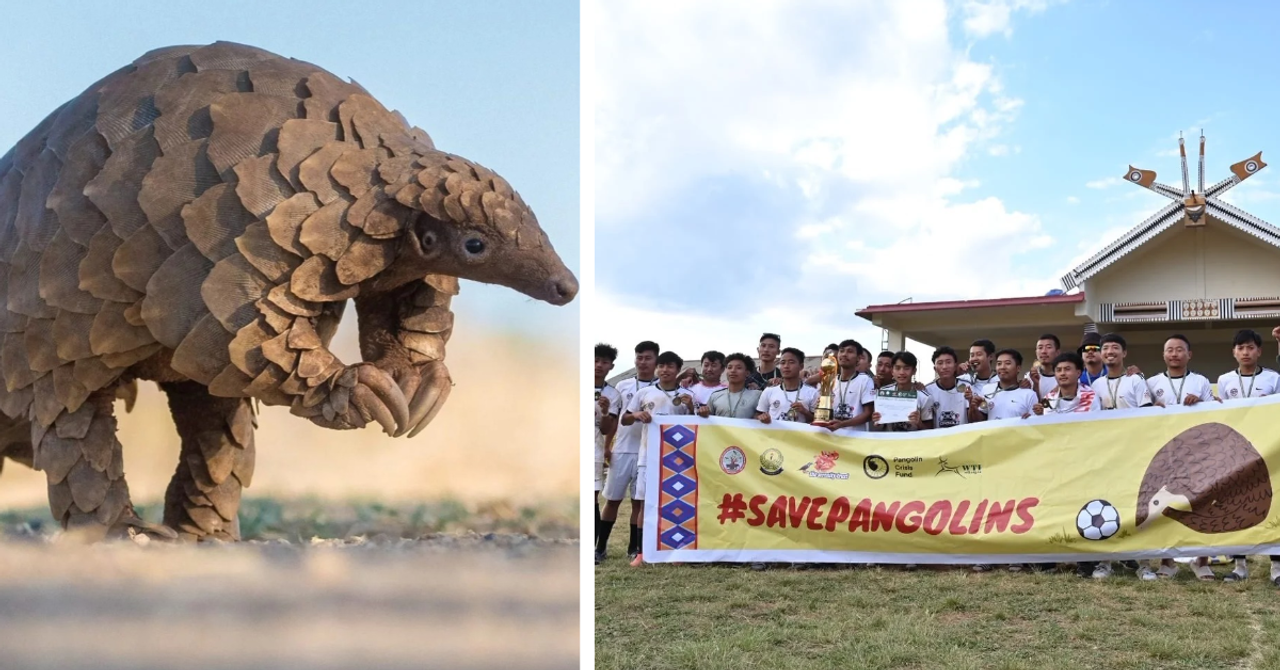
On 24 November 2026, Ngoushutho Ngouri spotted an unusual animal crossing a road near a residential area in Meluri, Nagaland. It was a Chinese pangolin, a critically endangered mammal threatened by hunting and the illegal wildlife trade.
Ngouri alerted forest officials, who rushed to the spot, examined the animal and found it healthy and uninjured. The pangolin was safely released into a forest habitat away from human settlements.
Just weeks earlier, the local community had come together over a shared love for football and made a collective decision to protect this very animal.
Across Nagaland, Manipur and Gujarat, similar efforts are showing how everyday decisions by residents, village leaders, farmers and fishers can help protect some of the world's most threatened species.
A football tournament with a purpose
In October 2026, eight football clubs from neighbouring villages came together in Nagaland for a rather unusual sporting event: the Pangolin Cup.
Organised by the Wildlife Trust of India (WTI), in collaboration with the Meluri Range Sports Association and the Nagaland Forest Department, the six-day tournament attracted at least 10,000 participants and spectators.
Between the excitement of football matches, residents learnt about pangolins, why they are hunted for their meat and scales, and how these animals help maintain forest ecosystems by feeding on ants and termites.
What followed went well beyond the football field.
The Pochury Hoho, the apex leadership body of the Pochury Naga community, passed a resolution banning pangolin hunting across 30 villages. Anyone found hunting or trading the animal would face a fine of Rs 50,000.
Weeks later, Ngouri's decision to alert forest officials offered a tangible example of how such awareness could translate into action.

Over 300 villages unite to protect pangolins
Elsewhere in Nagaland, village councils are using traditional systems of governance to protect wildlife.
In February 2026, the United Sangtam Likhum Pumji, the apex body representing the Sangtam Naga community, banned pangolin hunting across 42 villages in Kiphire district.
Following months of discussions with conservationists, village councils took responsibility for enforcing the ban, with violations handled by customary courts.
As reported by Mongabay, such resolutions are helping communities use their customary laws to protect endangered wildlife.
Neighbouring Manipur has seen similar efforts.
In August 2024, the Tangkhul Naga Awunga Long, the apex body representing the Tangkhul Naga community, signed a resolution banning pangolin hunting and consumption across 230 villages.
In April 2025, when farmers discovered a Chinese pangolin in farmland near Tangkhul Khullen village, they informed community leader Kashung Tennyson. The animal was subsequently rescued and released into the wild.
Together, these three community resolutions cover more than 300 villages, bringing local residents and traditional institutions into the fight against wildlife trafficking.
Fishers who cut their nets to save whale sharks
Thousands of kilometres away, along Gujarat’s coast, another community is helping protect the world's largest fish.
Until the early 2000s, whale sharks were hunted along the Gujarat coast for their fins, liver oil, skin and meat.
In 2004, WTI launched a conservation initiative in partnership with the Gujarat Forest Department and Tata Chemicals, working with fishing communities to raise awareness about the endangered species.
Over the years, fishers began voluntarily releasing whale sharks that accidentally became entangled in their fishing nets. Some even cut their expensive nets to free the animals, with a compensation programme helping cover their financial losses.
According to WTI, Gujarat’s fishing communities have helped release 1,042 adult whale sharks and 22 young ones.
In November 2026, these communities received national recognition from the Ministry of Environment, Forest and Climate Change for their contribution to whale shark conservation.
The initiative has also expanded to Kerala, Lakshadweep and Goa, where fishers are being trained to recognise and safely release whale sharks.

For a resident walking along a village road, a farmer working in his field or a fisher heading out to sea, an unexpected encounter with an endangered animal can become an opportunity to save its life.
By bringing conservation into their sports, traditions, livelihoods and everyday decisions, these communities are showing how ordinary citizens can play a meaningful role in protecting India's wildlife.
This content is published by The Better India and has not been created or edited by Hello Headlines. View original