
JNTU-Hyderabad campus harvests 10 crore litres of rainwater annually

Hyderabad: While several residential areas in the city are experiencing water shortages even during the winter season due to the El Niño impact, the Jawaharlal Nehru Technological University (JNTU)-Hyderabad has made its campus self-sufficient in water by harvesting 10 crore litres of rainwater annually.
The rainwater harvesting system, a brainchild of Prof MVSS Giridhar of the Centre for Water Resources at JNTU-Hyderabad, has turned the university campus into a zero-water-discharge zone. It has helped keep groundwater levels within 10 metres of the surface, with the depth reaching nearly 50 metres during the summer season.
Conceived more than a decade ago, the system helped restore groundwater levels not just on the 100-acre campus but also in adjacent colonies. It has now come in handy for the university amid the water shortage in the city.
As Telangana is part of the Deccan Plateau, conventional rainwater harvesting pits do not yield better results. This is mainly due to lower water penetration into the ground because of the rocky terrain.
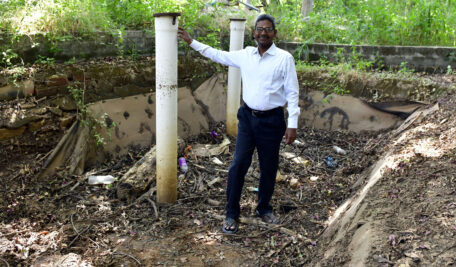
To address the issue, Prof Giridhar designed, developed and implemented a borewell-based rainwater harvesting system. The method involves drilling through the rock and connecting the surface rainwater collection structure to underground aquifers.
The recharge pit comprises four layers, with the bottom layer consisting of 40-60 mm gravel, followed by 20-40 mm gravel and coarse sand. Each of these layers occupies one-fourth of the pit’s depth. To filter dust and other floating particles, a geotextile sheet with 125-micron perforations is placed over the sand layer. Perforations made in the casing pipes allow water to enter the borewell and reach deeper layers.
Presently, 11 such rainwater harvesting structures and 24 recharge borewells on the campus are harvesting around 10 crore litres of rainwater annually, which would otherwise flow into drains as runoff or cause flooding near Rythu Bazaar.
Before these water recharge pits were constructed, several borewells had either gone dry or were functioning with reduced yields. The university used to purchase water through tankers at the rate of 30 per day to meet its requirements during the summer season.
However, the construction of rainwater harvesting structures resulted in improved water levels and increased the sustainability of existing borewells for pumping. “The university has not purchased a single water tanker in the last 15 years,” Prof Giridhar said.
Funded by the Central Ground Water Board, AICTE and TEQIP, the system has already received an Indian patent. According to Prof Giridhar, each structure costs around Rs 70,000 to Rs 75,000, depending on the site and the number of borewells required. “Ordnance Factory, spread across 3,500 acres, and over 100 welfare residential associations have already implemented this system. We have also shared this concept with Tirumala Tirupati Devasthanams and EPTRI,” he said.
He said he was ready to extend his technical expertise and hold workshops for residential welfare associations and other interested groups that want to install these rainwater recharging pits.
This content is published by Telangana Today and has not been created or edited by Hello Headlines. View original