
A Crane, a Duck & a Bird From the Arctic: What Happens When India's Wetlands Disappear?
When rising water threatened a Sarus Crane’s nest in Madanpura village in eastern Uttar Pradesh, two men stepped in.
Local volunteer Chedi Kewat alerted the Wildlife Trust of India (WTI) and worked with field assistant Ravindra Kumar Tripathi to secure the nest using bamboo poles.
Thirty-one days later, the eggs hatched.
It was one small rescue, but it tells us something important about India's birds. Their survival can depend on the pond beside a village, the marsh near a farm or the muddy shoreline along a coast.
And that is why a new national assessment of India's birds matters.
On 19 October 2026, WTI announced that experts had begun assessing 1,211 bird species regularly found across India. More than 100 preliminary assessments had been opened for expert review.
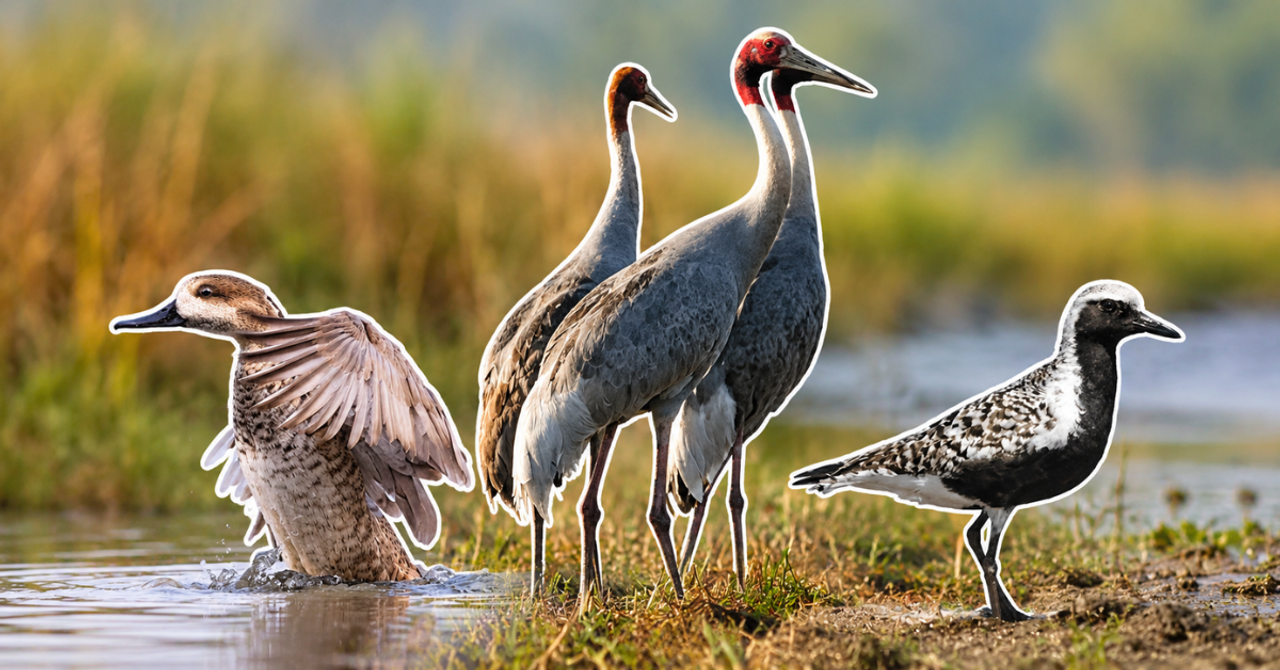
Among them, three wetland birds, the Sarus Crane, Marbled Duck and Grey Plover, offer a glimpse of what is at stake.
Why a pond beside a farm could decide a crane’s future
The Sarus Crane, the world's tallest flying bird, often makes its home in flooded paddy fields, village ponds and shallow wetlands.
During the monsoon, these places provide space to build nests and raise chicks.
But when marshes are drained, pesticides threaten birds or power lines cross their habitat, their survival becomes harder.

The Sarus Crane has been proposed as Vulnerable in India's new assessment, indicating a high risk of extinction in the wild nationally.
Uttar Pradesh has an estimated 19,000-plus Sarus Cranes. Across 10 eastern districts, WTI works with farmers, local volunteers called Sarus Mitras and village committees to monitor nests and protect wetlands.
These community efforts matter because many crane nesting sites lie beyond protected wildlife reserves.
The duck with fewer places to spend winter
Every winter, the Marbled Duck travels to India in search of shallow freshwater wetlands where aquatic plants provide food and shelter.
It has been recorded in Rajasthan, Haryana, Punjab and other states. But its proposed national conservation status is Endangered.
Marshes are being drained, water bodies are changing and suitable habitats are disappearing across parts of its range.
Because these ducks move between wetlands depending on water conditions, experts also need better monitoring to understand how their populations are changing.
A bird that crosses continents, but faces a worrying decline
The Grey Plover makes an extraordinary journey every winter, travelling from its Arctic breeding grounds to India's coastline.
Here, it searches for food in coastal mudflats, where the retreating tide exposes small creatures.

Its proposed national category is Least Concern. That sounds reassuring, but another assessment raises questions.
The State of India's Birds 2025 update estimated a 78.99% decline in its long-term population trend in India. Globally, the species is classified as Vulnerable.
This difference shows why experts must carefully examine population records and habitat changes before finalising a bird's conservation status.
What protecting these birds really takes
India's new assessment will examine where birds live, how many there are and whether their populations are changing. Birdwatchers' sightings and field research can help experts fill information gaps.
But identifying a bird's risk is only one part of protecting it.
Wetlands must remain places where birds can feed, rest and breed. These same habitats can also help nearby communities by recharging groundwater and reducing the impact of floods.
For Arshad Hussain, who works with local communities through WTI's Sarus conservation project, some of the happiest moments come when a farmer calls to report a new nest or a hatched chick.
In Madanpura, protecting one Sarus nest meant recognising the danger in time and acting together. Across India, that same care for everyday wetlands could give many more birds a better chance.
Sources:
‘India Launches Collaborative National Red List Assessment of 1,211 Bird Species’: By Wildlife Trust Of India, Published on 19 October 2026
‘Transitioning Wintering Shorebirds to Agroecosystem: A Thorough Evaluation of Habitat Selection and Conservation Concern’: By Diversity-Biodiversity Conservation, Published on 29 December 2023
National Wetland Inventory and Assessment (NWIA) Atlas
‘Mercury contamination: a hidden threat to long-distance migrant shorebirds in critical wintering sites on the west coast of India’: By K A Rubeena , K M Aarif, Published on 23 September 2025
This content is published by The Better India and has not been created or edited by Hello Headlines. View original