
Why Gramiyaa Had To Think Like A Supermarket To Win On Quick Commerce
It would be naive to think that getting listed on quick commerce platforms is half the battle won. If anything, that’s where the real battle begins. Building sales velocity, keeping products in stock, managing sky-high platform costs, and, believe it or not, we have barely peered into the abyss.
Gramiyaa, a premium cold-pressed edible oil brand, learnt this the hard way when it boarded the quick commerce bandwagon through Blinkit in 2024.
The first hurdle was affordability. When Gramiyaa finally made it onto quick commerce platforms, it found itself paying nearly twice the commission its national competitors paid. For a small brand already operating on razor-thin margins, that was a steep price to pay just to get a foot in the door.
On top of that, the brand had to set aside a hefty advertising budget, only to burn through it while learning the ropes and figuring out how to make the channel work.
After weathering several battles, including pricing wars between platforms, Gramiyaa has managed to turn the tables. Today, quick commerce is its largest revenue contributor, accounting for 35% of its ₹5 Cr monthly recurring revenue (MRR).
So, how did Gramiyaa navigate these hurdles and turn quick commerce from a costly gamble into its biggest revenue driver?
In an exclusive conversation for The Quick Commerce Code by Inc42 and Nitro Commerce, Gramiyaa cofounder Mohamed Yaseen shed light on what worked for the brand, how it managed to bring down platform commissions, and the dos and don’ts for emerging D2C brands looking to crack quick commerce.
Why Gramiyaa Had To Look Beyond Its D2C Playbook
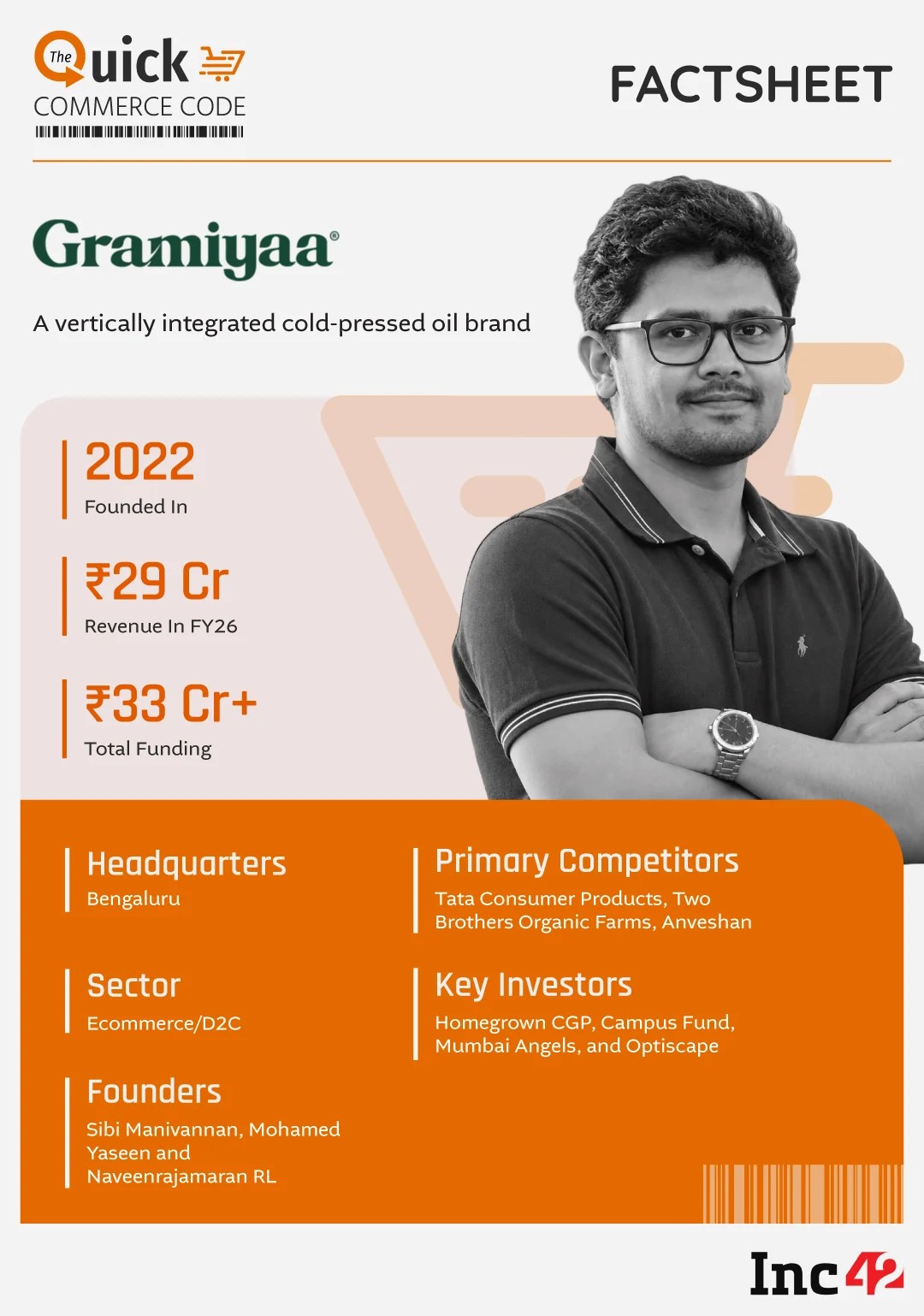
Founded by three friends, Mohamed Yaseen, Naveenrajamaran RL and Sibi Manivannan, Gramiyaa’s journey began in 2018 as a local offline business.
Manivannan’s grandfather ran an oil mill, and Manivannan wanted to breathe new life into the family business, which sold unbranded oil in PET bottles through five to six retail shops in Chennai.
While these shops brought in ₹15-20 Lakh a month, high rents and operating costs ate into the earnings. Besides, each store could only cater to customers in its immediate neighbourhood, leaving little room for growth.
“We had a very stable audience, but were not moving anywhere in terms of growth,” Yaseen told Inc42.
In 2022, Yaseen and Naveenrajamaran RL joined Manivannan, and the three decided to build a new company. Gramiyaa was born.
The founders initially took the D2C route, selling through their own website and setting up small warehouses across four metros to deliver orders within a day. They also looked beyond India, tapping distributors that catered to the Indian diaspora in the US, to take their products overseas. This gave the company a small but high-margin revenue stream.
“However, this was not enough, even though we were doing quite well from our website,” Yaseen said.
As a brand selling only cold-pressed oils, Gramiyaa could attract only so many customers to its own website. To reach a wider audience, the founders decided to list their products on Amazon in November 2022. But this came with an unexpected trade-off. Instead of bringing in only new customers, Amazon began eating into Gramiyaa’s existing D2C sales. Customers who previously bought from its website started ordering through the marketplace, where the brand earned less on every sale.
With its own website offering limited room for growth and Amazon eating into margins, the founders began looking for another avenue to scale, and quick commerce seemed like the obvious next step.
The High Cost Of Breaking Into Quick Commerce
The founders were convinced that quick commerce was a channel they could no longer afford to ignore. But wanting to get on board and actually making it happen were two different things.
For nearly a year, the Gramiyaa founders remained hesitant. The reason? Blinkit and Instamart’s steep commissions. With the brand operating on a razor-thin profit margin of just 2-3%, the cost of entering quick commerce was simply too much.
“This was one year of anxiety and worry. We wanted to do this but couldn’t,” Yaseen recalled.
According to him, if a national cooking oil brand paid a commission of X to a quick commerce channel, a premium oil from a national brand paid about 1.5X. And Gramiyaa, a small and unproven brand, had to pay twice as much.
However, Yaseen argues that quick commerce is not necessarily more expensive than other distribution channels. Consider a product selling for ₹400, where the brand needs to retain ₹300. The remaining ₹100 goes towards platform margins and advertising on quick commerce. In traditional retail, a similar amount could be absorbed by distributor margins, retailer commissions and the cost of maintaining a sales team.
The bigger challenge for smaller brands, therefore, is not just the cost of distribution, but having enough capital to absorb these expenses before the channel starts generating meaningful sales.
The advertising commitment made the decision even harder. According to Yaseen, brands entering quick commerce with three to four SKUs may be expected to spend ₹5–10 Lakh a month on advertising, even before they have established consistent demand. For a business like Gramiyaa, which was operating on margins of just 2–3% at the time, committing such capital without any assurance of sales was a significant risk.
The decision was eventually made, and the brand got listed on Blinkit in 2024. But after the listing, the channel remained loss-making for nearly six months. According to Yaseen, most brands that do reasonably well on quick commerce barely break even or lose money for six months to a year, and Gramiyaa was no exception.
“Brands without the capital to absorb this often pause or shut down their quick commerce operations. Thankfully, we had raised funding by the time we went in,” said Yaseen.
For Gramiyaa, the commissions came down once it proved that demand was pulling customers toward the platforms. When its sales grew from ₹5 Lakh a month to ₹10-15 Lakh and repeat purchases showed that some customers would switch apps, the platforms began treating it more like a large brand.
“Our margins eventually moved gradually closer to what national brands paid,” Yaseen said.
The One-City, One-SKU Strategy Behind Gramiyaa’s Growth
On ecommerce platforms like Amazon, Gramiyaa could ship products to customers anywhere in India from a central warehouse. How well a product ranked depended on how many people clicked on its listing and went on to buy it. Where those customers lived hardly mattered.
Quick commerce, however, is a different ball game altogether. Here, what matters is how quickly a product is sold in a particular neighbourhood.
The challenge becomes clearer at the dark-store level. A slow-moving product may get just one unit of inventory in a particular store. Once a customer buys it, the product can remain unavailable for the next 24–48 hours until it is replenished. Unless the product consistently sells in that locality, platforms have little reason to increase the inventory allocated to it.
This creates a difficult cycle for smaller brands. Limited inventory leads to frequent stockouts, but without sustained sales velocity, securing additional inventory becomes equally difficult.
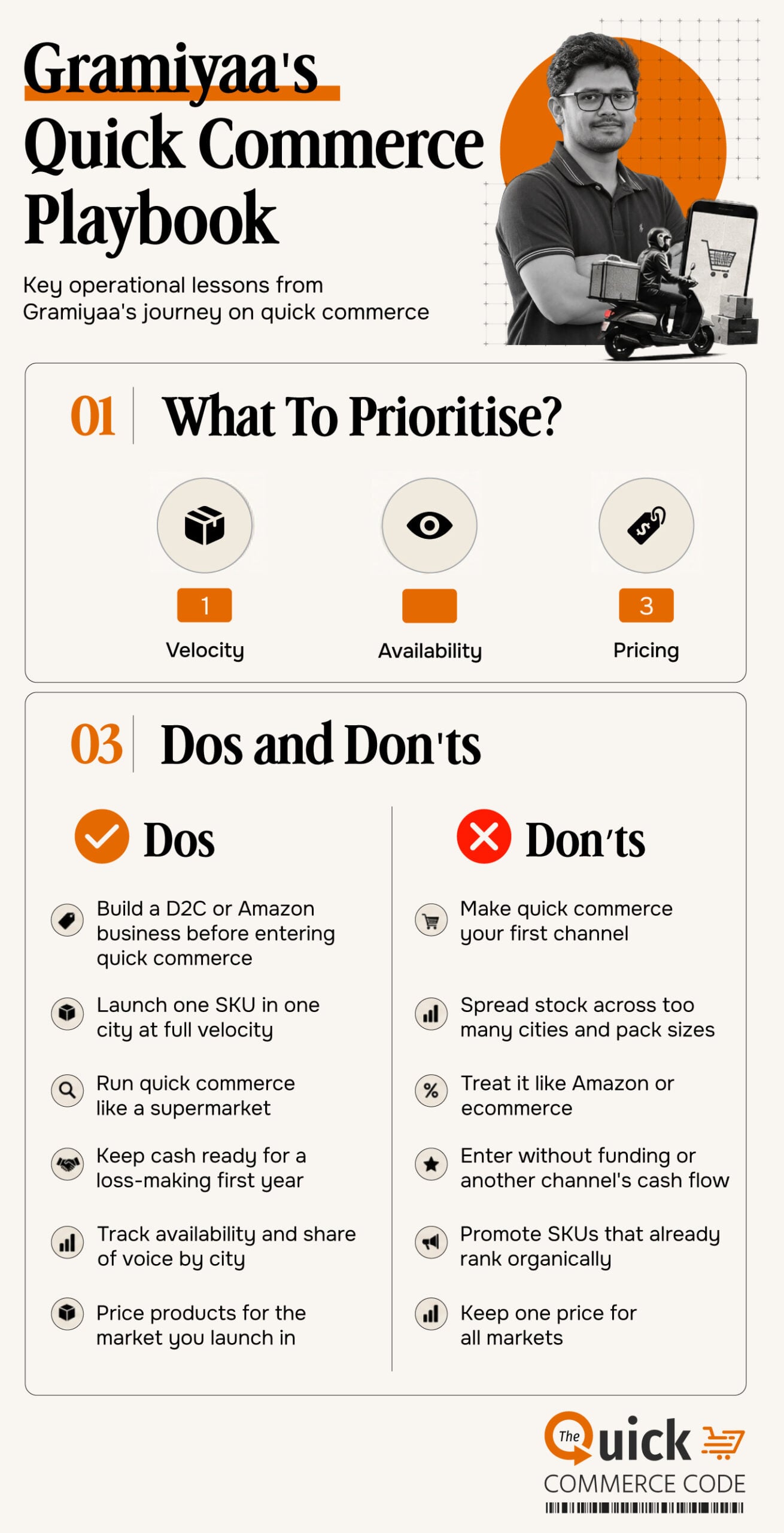
Yaseen’s rule is that a brand with full confidence in a product in one city should launch there alone, rather than spread across four cities where it is only fairly sure. Within that city, the product has to sell quickly in at least half the dark stores before platforms begin stocking it more deeply.
“Velocity is everything,” Yaseen said, adding that it was the hardest shift for Gramiyaa’s team.
Its ecommerce managers were used to optimise listings and found it difficult to plan around availability in each locality. Yaseen took charge of the channel himself and pushed the team to learn how supermarkets and general trade distributors manage stock in each area.
“I believe supermarkets have more in common with running a kirana counter than with running an Amazon listing,” said Yaseen.
To understand where its products were selling and where they weren’t, Gramiyaa began tracking performance city by city. An intern manually checked pin codes to see where its products appeared in search results and whether they were in stock.
Today, the brand uses tools such as Nitro Commerce to track these metrics, with Yaseen checking the dashboard every morning.
The exercise revealed two trends:
- In some areas, platforms weren’t stocking Gramiyaa’s products at all.
- In other areas, demand was strong enough for products to sell out quickly
Armed with these data points, the brand began pushing platforms to stock more units wherever demand was high.
The same data-driven approach helped Gramiyaa optimise advertising spend. Yaseen realised that the company was sometimes paying to promote products that were already ranking well organically on quick commerce apps. By tracking organic and paid share of voice at the SKU and city level, the team began redirecting advertising budgets towards products and locations where additional visibility could make a difference.
This allowed Gramiyaa to make better use of its marketing budget rather than spending indiscriminately across products that were already generating sales.
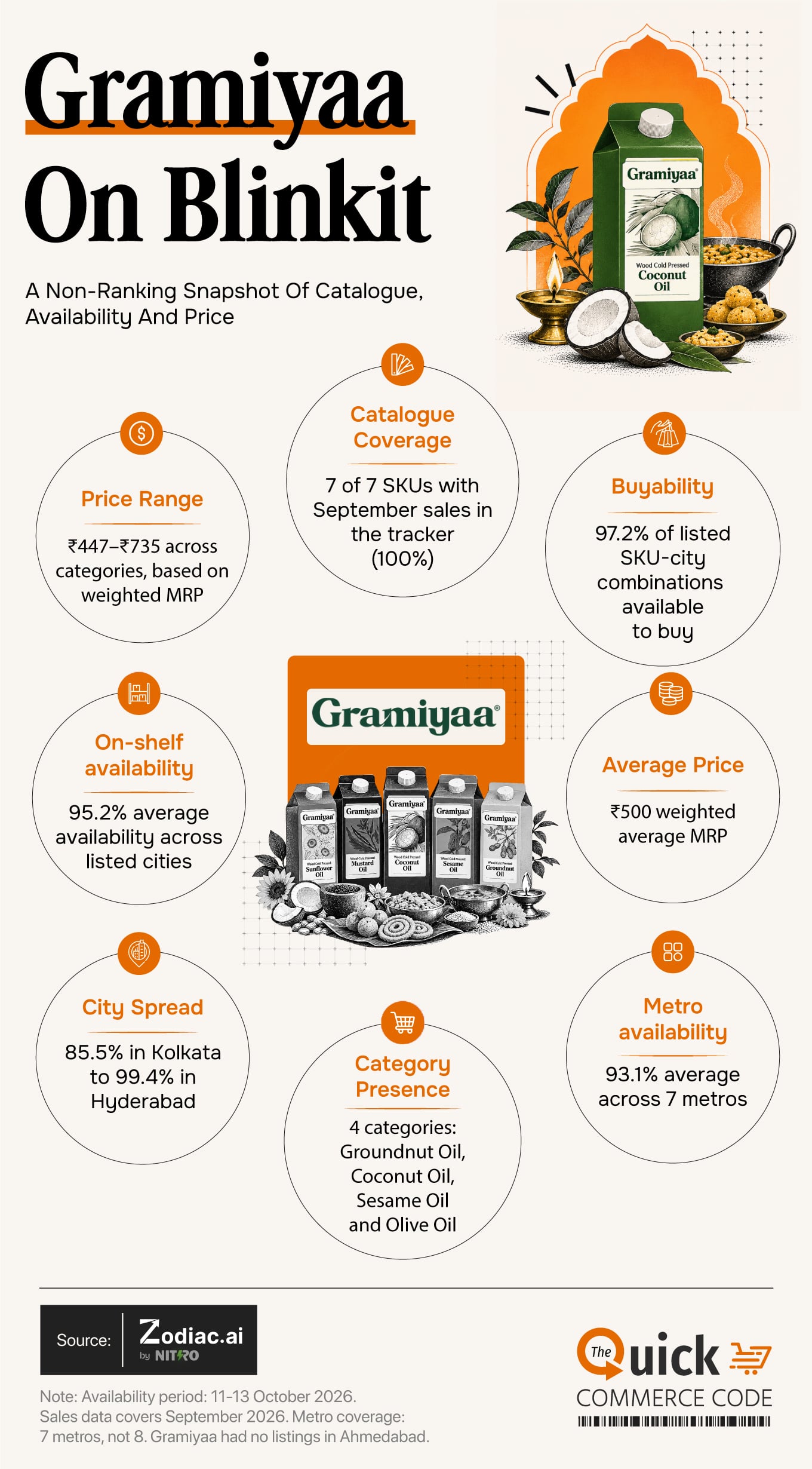
Over time, product availability became one of Gramiyaa’s most important metrics. The brand now targets 90% on-shelf availability (OSA) and typically achieves 85-90%. According to Yaseen, even the category leader manages only 92-93% in its best month.
And this is where Yaseen sees an opportunity for smaller brands. “When a leading brand runs out of stock, customers often turn to alternatives. If Gramiyaa is available at that moment and its product meets their expectations, it has a chance to win over a new customer,” the cofounder said.
The Big Trade-Off: Pricing, Assortment And Availability
Gramiyaa’s best-selling product on quick commerce is groundnut oil, and its best-selling size is one litre. At one point, it also listed half-litre bottles, a size only a few brands bet on. Yaseen expected it to work as a cheaper trial pack.
At first, the half-litre pack made up 30% of groundnut oil sales. The team expected that share to fade, but it held. Today, the smaller half-litre packs account for about 15% of total sales volume, which is roughly 30% of its customers.
This revealed an insight that its young and conscious customers cook occasionally, and others plan their groceries monthly, buy large packs on Amazon, and only use quick commerce when they run out a few days early.
Adding smaller pack sizes seemed like a good way to attract more customers, but it came with a trade-off. Dark stores have limited shelf space and stock for each brand. If Gramiyaa stocked both half-litre and one-litre bottles, its inventory would be split between the two sizes. A competitor selling only one-litre bottles could stock more units of that size and stay available for longer.
Yaseen decided to prioritise the larger pack, even if it meant losing customers who preferred smaller quantities.
“If you’re the 20% of customers who won’t buy my brand without the half-litre, I will let go of you. But the 80% who buy my one-litre, I want it repeatedly available for them,” he said, advising new brands to start with a single SKU and choose a product category where larger brands have left a gap.
Not every product decision worked out for Gramiyaa. Of the four oil products the brand introduced on quick commerce, one failed to gain traction because it could not be priced competitively. Yaseen acknowledged that the company had pushed ahead with a product despite knowing it was overpriced and not particularly suited to its core customer base in southern India.
The experience reinforced that expanding an assortment does not necessarily translate into higher sales, especially when dark-store inventory is limited, and a poorly performing SKU can tie up resources better allocated to bestselling products.
Pricing was another headache for Gramiyaa. Yaseen shared that platforms were changing the selling price of their products to match competitors.
For example, if Instamart offered a discount on one of its SKUs, Blinkit was just going ahead to match that price for the next 20 days to recover its margins. At times, as Yaseen shared, platforms also asked Gramiyaa to cover the price difference.
“We get caught between two giants fighting to acquire customers,” Yaseen said.
These price fluctuations caused significant losses for Gramiyaa in its early months on quick commerce. It took the company nearly five to six months of negotiations to bring platform margins closer to each other and push back against pricing changes and penalties that were beyond its control.
The pressure was compounded by competition from much larger FMCG players. Yaseen credits Tata with helping popularise the cold-pressed oil category, but its aggressive push has also intensified price competition. For a smaller brand like Gramiyaa, competing on discounts against national players with deeper pockets was never going to be a sustainable strategy.
Yaseen believes that while a popular product such as groundnut oil can help a brand establish itself on quick commerce, its longer-term position will depend on building a presence in more differentiated categories. For Gramiyaa, this makes products such as coconut and sesame oil important, particularly in segments where larger FMCG companies may not be competing as aggressively.
Today, Yaseen shared, Gramiyaa does not need to rely heavily on discounts to drive sales. At ₹350-750, a single one-litre bottle is expensive enough to qualify for a platform’s free delivery threshold.
The purchasing behaviour also works in Gramiyaa’s favour. According to Yaseen, its customers typically reorder every 40–45 days and buy an average of 1.3-1.4 products per order, while ₹350 is an effective price point for the brand on quick commerce.
Unlike lower-ticket products that may depend on being added to a larger grocery basket, a single bottle of Gramiyaa’s oil can account for a substantial portion of the order value. Combined with repeat demand, this gives the brand an advantage in building consistent sales velocity.
Gramiyaa’s Next Quick Commerce Test
Gramiyaa reported ₹18 Cr in revenue in FY25, which grew 61.1% to ₹29 Cr in FY26, with quick commerce the largest channel at 35%, or about ₹10.15 Cr. But this growth has come at the expense of profit.
According to Yaseen, the brand was profitable in FY25. As of now, remaining profitable is the least of its concerns, as the company expects to burn for brand visibility and new channels.
Recently, Gramiyaa raised ₹21 Cr as part of its ongoing Series A fundraise led by Optiscape Network Holdings, Homegrown Ventures, Campus Fund and others. The funds would be used to fuel its expansion in Tier II markets.
For Gramiyaa, the next phase of quick commerce growth lies beyond India’s metros. Yaseen believes the channel’s appeal in Tier II cities is somewhat different from that in larger markets. Rather than simply promising delivery within minutes, quick-commerce platforms are increasingly offering consumers access to products that may not be readily available at their neighbourhood kirana stores.
For a premium cold-pressed oil brand with limited offline distribution in these markets, that creates an opportunity to reach customers who might otherwise struggle to find its products locally.
The company expects quick commerce to remain its largest revenue channel as it expands into these markets. However, Yaseen acknowledges that the next phase will depend on how successfully platforms penetrate smaller cities, particularly as growth in established metro markets begins to moderate.
However, when asked about platforms prioritising their own labels over D2C brands, Yaseen does not see much competition there, as the brand operates in the premium category, selling to customers who prefer quality over price.
But for founders considering the channel, Yaseen’s advice is to wait.
“Quick commerce should be built only after a brand has a core business on its website or an ecommerce platform like Amazon. They need to know their hero products, figure out pricing, and have strong liquidity from another channel or cash flow,” the cofounder stated, outlining the imperatives for newer brands stuck at the bottom of the pyramid.
Gramiyaa avoided this trap, but the harder test of holding its position in Tier II cities is yet to come. Can it sustain demand in markets where premium purchases often take a backseat to essential spending?
The post Why Gramiyaa Had To Think Like A Supermarket To Win On Quick Commerce appeared first on Inc42 Media.
This content is published by Inc42 and has not been created or edited by Hello Headlines. View original