At 75, He Still Carves the Tiny Wooden Tool That Helps Turn Thread Into Kashmir’s Pashmina
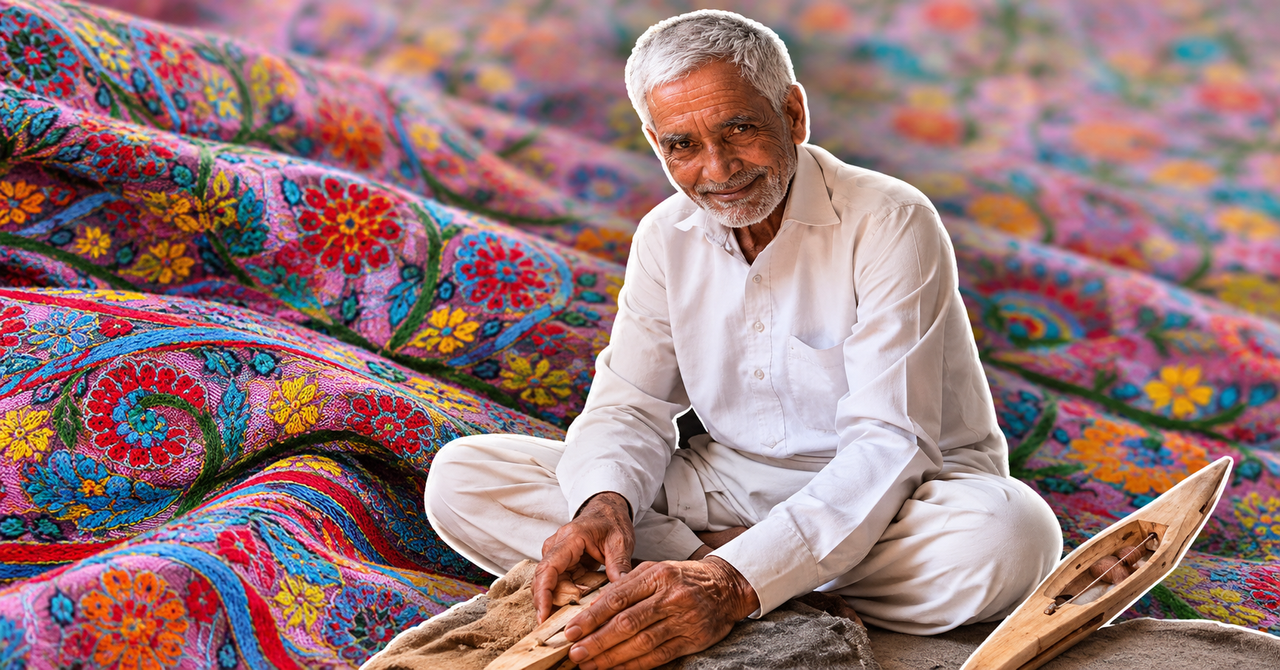
At 75, Abdul Majeed Zargar still works with a craft that few people outside Kashmir’s weaving workshops know exists. From his home in Amda Kadal Jogiwan, Srinagar, he hand-carves the wooden shuttle used to weave the region’s celebrated Pashmina shawls.
Known locally as the Mukh, the small tool carries the thread that makes every woven piece possible.
Zargar is believed to be the last craftsman in Kashmir who makes these shuttles by hand. For nearly five decades, he has shaped wood into a tool that connects generations of weavers, even as the traditional skills behind Kashmir’s textile heritage face declining demand.
His story began with uncertainty. Before finding his calling, Zargar tried his hand at silver-making and knife-making.
Neither trade worked for him, and he eventually turned to making Mukhs. Learning the craft took almost a year, during which he struggled to produce pieces that met the standards of experienced weavers.
When he finally had a few shuttles ready to sell, he carried them from one workshop to another. Most people turned him away. He was close to abandoning the craft when a meeting in Khayam changed his life.
Three shuttles that changed everything
Zargar approached a sazvari, a trader who bought and sold weaving tools. The trader invited him upstairs, where experienced craftsmen were working. Nervous, Zargar showed them his handmade Mukhs.

They examined the pieces carefully and pointed out their flaws. Yet, before he left, they bought three pairs. The shuttles were not good enough for weaving, but the craftsmen wanted to encourage him to continue.
When Zargar returned months later, he found the pieces still hanging on the wall. They had never been used.
He asked why they had bought them if they were faulty. Their answer stayed with him: “If we had not bought them, you would have lost hope.”
The craftsmen also recommended him to other weavers and traders, helping him find customers who needed new shuttles or repairs. Slowly, his work improved, and his Mukhs became known for their quality and durability.
There were times when weavers had to wait months for one of his handmade tools.
That early encouragement became the foundation of a career spanning five decades.
The tiny tool behind every Pashmina
A Mukh may appear insignificant beside a finished shawl, but it performs one of the most important tasks in traditional weaving. The shuttle carries the weft yarn back and forth across the warp threads on a loom, allowing the fabric to take shape.

Without it, the loom cannot function. Every handwoven Pashmina or Tusha shawl depends on this simple movement before it can reach the stages of dyeing, embroidery and finishing.
Zargar calls the Mukh the basis of Pashmina. Its importance lies not in its size or appearance, but in the work it enables. The tool connects the weaver to the larger ecosystem of Kashmiri textile artisans, whose skills transform delicate fibres into intricate fabrics.
Over the years, Zargar has also improved the traditional design. Earlier, the metal components of the shuttle were made of iron, which could rust. He replaced them with brass, making the tool more durable and resistant to corrosion.
Today, factory-made shuttle boats are cheaper and more readily available. But Zargar believes that the handmade Mukhs remain superior in quality and longevity. His tools are carved entirely by hand using chisels and files, without modern machinery.
Passing down a dying craft
The challenge facing Zargar is not simply the availability of tools, but the shrinking demand for traditional handloom weaving itself. As power looms replace handlooms and younger people move towards other professions, the need for handmade shuttles has declined.

Zargar has tried to teach others, but finding willing apprentices has been difficult. Many young people prefer computer-based jobs or work in cities, leaving fewer people interested in learning a specialised craft that requires patience and years of practice.
Despite decades of recognition and support from the Department of Handicrafts, he worries that awards alone cannot preserve the skill. What matters, he said, is that the craft continues.
He is now teaching his son, hoping the knowledge will survive beyond his own lifetime. The work remains painstaking, and the future uncertain, but Zargar continues to carve the wooden tools that weavers depend on.
“I do not know what will happen after me,” he told Kashmir Life. “But as long as I can hold my tools, I will keep making them.”
For Kashmir’s Pashmina, the survival of a centuries-old weaving tradition may depend on a small wooden shuttle, and on whether someone is willing to learn how to make it.
Sources
'Kashmir’s Last Shuttle': by Afreen Ashraf for Kashmir Life, Published on 10 July, 2026,
'Meet Abdul Majeed Zargar: Kashmir’s Last Surviving ‘Mukh’ Craftsman': by Jahangeer Ganaie for Kashmir News Observer, Published on 19 May, 2025
'For Want of a Tool, Kashmir’s Famed Pashmina Industry Is Crumbling': for Moneycontrol, Published in 2021
This content is published by The Better India and has not been created or edited by Hello Headlines. View original