
Pronto’s Second Shift
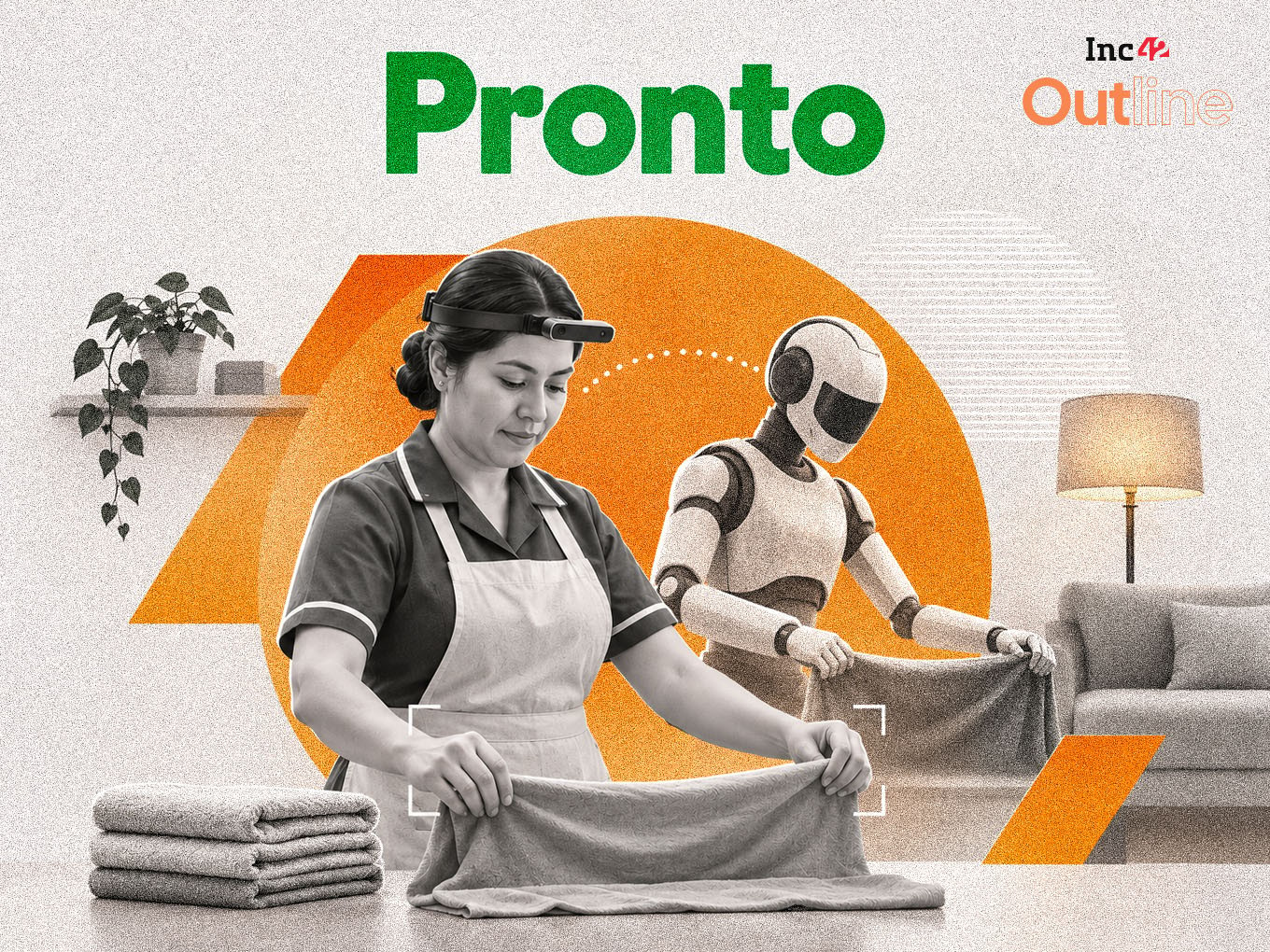
Anjali Sardana and Pronto entered India’s domestic services market in 2025 to solve a familiar urban problem: finding reliable house help on demand. The result was a quick commerce-style home services platform, combining technology-led recruitment, standardised training and a hyperlocal network of professionals.
Pronto, which competes with Snabbit and Urban Company, says it has served more than half a million households across 11 cities. But the real story of Pronto is being developed far away from the homes and houses that its professionals visit.
This is being built in Silicon Valley.
Footage recorded by professionals working in thousands of homes every day is helping shape the next generation of robots.
The first signs of this ambition emerged in May 2026, when Pronto was reported to be exploring ways to generate physical AI training data using footage captured during household chores. And since then Sardana and Pronto’s ambitions have solidified.
In July, Pronto formalised the experiment through Verified, an opt-in premium service in which housekeepers and cleaners wear head-mounted or body-mounted cameras during visits.
In October 2026, Sardana set up Provision Labs, a physical AI venture based in San Francisco, which will collect data to train and test AI systems designed to perform real-world tasks using robots and other machines. It will work with developers building physical AI models.
A few days later, Provision Labs announced that it is acquiring Mumbai-based Basilisk Industries, a 2023-founded company focused on perception technologies, which help machines interpret their surroundings.
Basilisk founder Shourya Watwani will lead Provision’s hardware efforts and work on its in-house post-processing models. Watwani and his team are said to have developed a 3D hand-tracking model and built the first version of a lightweight tactile glove to capture touch-related data.
Given this timeline, the fact that Pronto doubled-down on its experiment after the May 2026 introduction does not seem surprising at all.
The relationship between Pronto’s household data collection and Provision Labs’ operations, however, remains unclear. Inc42 asked Pronto how the two businesses work together, if at all, but the company declined to comment.
The unanswered question is significant: could a network originally built to deliver household services become an acquisition channel for the data needed to train global robotics systems?
Why Record Workers?
The first reports around Pronto’s collection of worker data triggered a backlash over surveillance and privacy of house help professionals.
To assuage some of the critics, Pronto said that customers are informed about the terms several times before recording begins, while personally identifiable information is automatically blurred or removed on the device.
“The raw footage is deleted immediately after the work is done, and no one ever accesses it. For 48 hours, an anonymised, end-to-end encrypted recording is available only to the customer, who can watch it in the app to check the work. After that, we use the anonymised footage for AI training, as our terms set out,” the company told Inc42.
Pronto said more than half of the professionals participating in Verified already earn over ₹40,000 a month. The company claims workers feel safer knowing there is a record of their work, but no independent studies have been conducted to validate these claims.
What’s the point of all this?
Unlike chatbots, which can learn from the enormous repositories of text and images available online, physical AI systems need to understand how the real world works. A robot must learn how to pick up objects, fold clothes, navigate a room, and respond when something does not go as expected.
This requires large volumes of real-world, multimodal data capturing movement, spatial information and interactions with objects. Such data is considerably harder and more expensive to collect than internet-sourced text and images. ANI quoted a Goldman Sachs report estimating that general-purpose robots could require around 10 Mn hours of high-quality physical interaction data to reach production-level capabilities.
The Missing Data Layer
One can see the physical AI stack through four layers. The data layer captures real-world interactions, while the model layer uses this information to train vision-language-action models that translate what a robot sees into actions.
The simulation layer through platforms such as NVIDIA’s Isaac Sim allow these models to be tested in virtual environments before deployment. Finally, the edge layer runs them on physical robots, with real-world feedback informing and enhancing the training process.
Global technology companies such as NVIDIA, Google DeepMind, Amazon, OpenAI and Anthropic are building capabilities across the model and simulation layers of physical AI.
India has some representation at the robotics and deployment end, with companies such as Addverb, CynLr and Perceptyne developing robotic systems and automation technologies.
But it is the data layer that is seeing a growing crop of Indian startups, alongside global data companies building collection operations that rely heavily on India’s workforce and physical environments.
Humyn Labs, EgoData, Egolab.ai, Neocambrian AI, Human Archive, and Objectways have deployed people on the ground to collect footage across household chores, but several are also working with manufacturing units and other industrial environments.
Head-mounted or body-mounted cameras and sensor-equipped gloves or even full body suits have become commonplace as the next phase of robotics takes shape.
For India, the opportunity has echoes of its earlier role in the AI supply chain. Over the past decade, India has become a hub for data annotation, with workers labelling images, text and audio used to train AI models.
Physical AI takes that outsourcing model a step further. Indian workers’ movements, workplaces and interactions with objects are becoming the training material.
Abhinav Kukreja, founder of Neocambrian AI, sees India’s large and diverse physical environments as an advantage over markets such as the US, where access to comparable real-world data is more limited.
He believes the next phase of robotics will see an explosion of different embodiments and form factors. For India to participate meaningfully in this transition, it needs to control an important part of the underlying ecosystem. “I strongly felt that this layer would not be compute, architecture or algorithms, but the data layer,” he said.
Y Combinator-backed Human Archive is pursuing a similar opportunity, with a model that involves home service workers, cooks, cleaners and domestic help wearing cameras inside homes and private properties.
Cofounder Rushil Agarwal told Inc42 earlier that the Indian market’s appeal lies in the diversity of industries accessible within the geographical boundary and the large labour pool. This is difficult to replicate in the US.
Notably, Human Archive was evaluated by Snabbit too as it looked to launch a Pronto-like data collection pilot. However, the home services company eventually dropped the proposal.
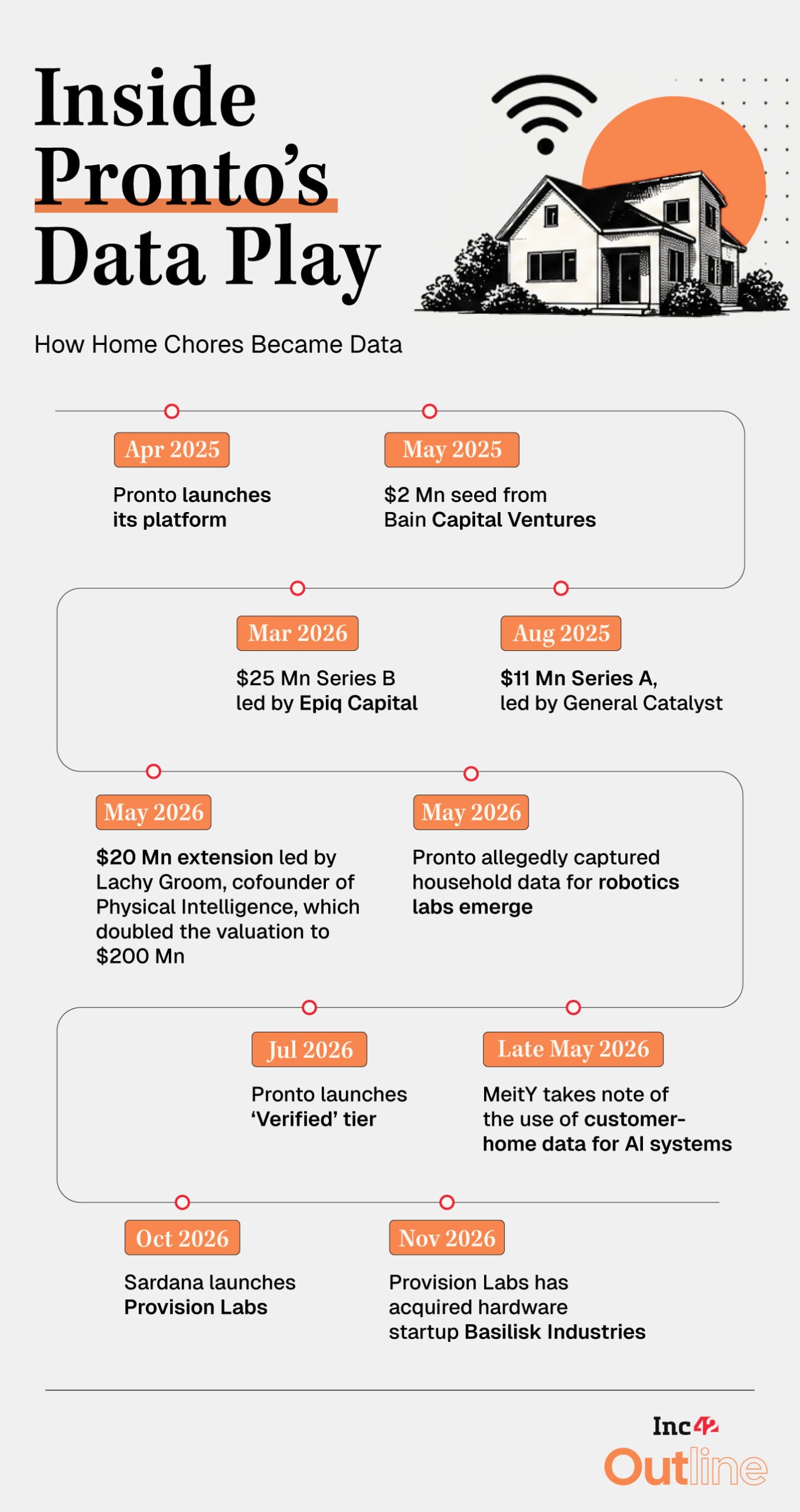
Human Archive raised $8.2 Mn in a seed round led by Wing Venture Capital and NVP Capital. Pronto’s $45 Mn Series B also saw participation from Lachy Groom, cofounder of robotics model startup Physical Intelligence; Groom has also backed Provision Labs. Bengaluru-based Humyn Labs, led by former Nazara CEO Manish Agarwal, has committed $20 Mn towards expanding its data collection network.
The supply side, meanwhile, is becoming more competitive. Data collection rates fell 30% between January and June this year, an industry executive told Inc42 earlier.
More suppliers have since entered the market and synthetic data generation has improved rapidly. But in the long run, the demand for human-captured footage could shrink as physical AI models mature.
The larger question is who captures the value and what happens to the workers. We’ll come to the latter soon, but the current situation does not give us any clarity on what this segment might look like in a few months.
While Pronto says more than half of its Verified professionals earn over ₹40,000 a month, Human Archive has cited compensation in the range of $1-10 per hour for its data collection work. These disparate compensation structures highlight the lack of clarity on the economic model. One cannot draw parallels between the kind of data captured either till the industry further matures.
At this point, companies are throwing a lot more money than they are willing to to attract workers who will readily collect data that can in a few years replace them.
Indian manufacturers and industrial units may recruit workers, deploy cameras and collect footage, while the resulting models and intellectual property are developed and owned elsewhere. This value drain could have serious consequences on the Indian economy and the jobs landscape.
For data suppliers, the challenge will be moving beyond one-off collection contracts to building differentiated datasets that command lasting value. As more and more companies come into the picture, the collection of egocentric data and first-person footage is about to become highly commodified and consumerised.
The Elephant In The Room: What About The Workers?
Like we mentioned, the business opportunity comes with a difficult labour question. The blunt reading of the matter is that Indian workers are training the robots that could eventually replace them.
Videos circulating on social media have raised concerns about whether workers even understand why they are wearing cameras. Some workers have reported discomfort from prolonged use, which may stretch to 5-10 hours a workday, while others believe the devices are intended to monitor their productivity.
Every company maintains that workers are informed about what is being captured and why. However, when collection happens through partner businesses, the responsibility for communicating this information shifts to those partners.
An openDemocracy investigation, meanwhile, found that workers at two Delhi factories were asked to wear cameras supplied by Egolab.ai without being told their purpose.
Such incidents raise questions about informed consent, compensation, the privacy of other people captured in recordings and ownership of the resulting data.
India’s Digital Personal Data Protection Act, whose implementation is scheduled for May 2027, adds another layer of regulatory uncertainty. Speculation is that the government may regulate these services, but to what extent can it stop individuals from participating is unclear.
For Sardana and Pronto, the opportunity is significantly larger than just a quick home services platform.
The data from the broad range of everyday human activity by Pronto workers can fuel Provision Labs and Basilisk’s next big plays and turn them into even bigger companies than Pronto.
Whether Pronto and Provision Labs will eventually work together has not been answered. But the value of Pronto’s network may very soon be the footage of what its professionals do, rather than the quality of the service itself.
[Edited by Nikhil Subramaniam]
The post Pronto’s Second Shift appeared first on Inc42 Media.
This content is published by Inc42 and has not been created or edited by Hello Headlines. View original