From 27 Sewing Machines to Factory Jobs, How Aarey’s Warli Women Are Stitching New Beginnings
While making my way to Mumbai’s Aarey Forest (the city’s last green lung), I take the Aqua Line underground metro corridor.
But throughout my ride, I can’t ignore the nagging feeling that this choice of transport is almost sacrilege, given that its construction sparked an uproar in 2019 when it threatened to displace 27 Warli Adivasi communities that have called the forest home since the 1950s.
But the metro is what will get me to my destination in the quickest time, and so I ignore the nagging guilt.
In 2019, many of my trips were to the same forest to document the protests (as a journalism student); today, the purpose of my trip is different. The years have witnessed the community women being empowered through a stitching programme that has “changed their lives”, according to many of their accounts.
What began as an informal way of channelling their skills into a purpose has now solidified into formal jobs in factories across Mumbai.

Their stories echo the resilience of a community that has repeatedly had to adapt to a city growing around it. The same women whose homes and livelihoods once stood at the centre of a battle over Aarey’s future are now finding new ways to assert their place within Mumbai’s economic landscape.
Through sewing, they have transformed a skill passed down within the community into a source of income, confidence and independence.
What began as a small stitching initiative has, for some, become a pathway to formal employment.
A conversation among the trees
It’s a Sunday morning when I plan my visit to the forest. While I was told that the women who work through the week would be at home (Sunday is their weekly off from the factory), the hamlets seem quiet. Surekha Burkhud (40), who lives in Khambachapada and has stayed back, shares that the factory had a sudden urgent requirement for a bulk order, and so the women were called. But she is quick to add, “The women don’t mind going because they are paid OT (overtime). This is double their usual day’s pay.”
It’s just Surekha and me and the trees for company: chickoo, guava, jamun and ber (Indian jujube). Drawing on context from them, she starts by emphasising the community’s love for the trees in Aarey. “These were planted by some of the oldest members. When the metro was being built, we were so disturbed by the fact that our trees would get destroyed. They are our life,” she shares.
According to reports, hours after the Bombay High Court (HC) dismissed several petitions of the locals seeking Aarey to be declared a protected area, on 4 October 2019, opposing the construction of a 33-hectare metro car-shed in the forest, the Brihanmumbai Municipal Corporation (BMC) felled approximately 2,700 trees over the course of two days. Several protestors were detained, beaten up, and 29 were arrested on serious charges under Section 353, Section 332, Section 143 and Section 149.
Seeing it pained the community members.
I ask Surekha whether she’s travelled by metro, given their aversion to its construction. She admits she has.
“I was scared of being underground for so long,” she sheepishly acknowledges. While admittedly the Aqua Line 3 has eased public commute for Mumbai’s residents — reports had pegged the metro to eventually carry around 1.7 million passengers every day and bring down the number of vehicles on the road by up to 650,000 — Surekha says they find it inconvenient to access the metro as the car shed is built close to the hamlets, but the actual boarding gate is near Seepz.

In addition to this, a common complaint they have is that because of the car shed area, water collects during the rains, causing flooding.
That being said, the community is happy that for “the time being” their hamlet is safe. “But we never know,” Surekha shrugs.
A PARI report had documented the plight of other Warli Adivasi families that weren’t as fortunate as hers. Locals estimate that 70 Adivasi families lost their homes to the metro project. From 27, the number of padas is now down to 15.
But the community is resilient.
And this same quality has helped them become empowered entrepreneurs. While forest produce was once their means of sustenance, tree felling in 2019 made them realise they needed to divert their attention to other income streams. They needed to recalibrate their lives.
Weaving a story of change
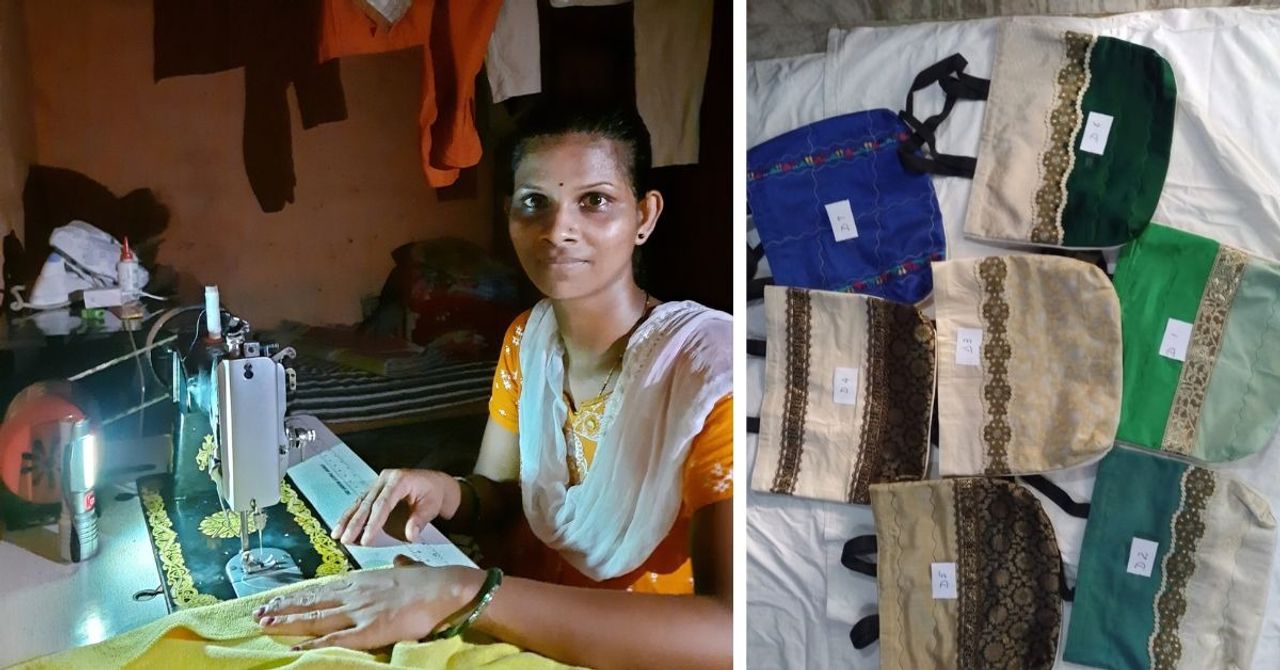
For Geeta Page (32), hope equates to a sewing machine.
Her mud home in Khambachapada has a single bulb, whose light doesn’t reach her work spot. Despite the fact that it is 11 am when these interviews are being conducted, Geeta’s home gives the semblance of late evening. Her eyes bear the brunt of her determination, as she sews in the dimness of the room.
“We stitch when we get orders. It takes five days to make a quilt, and we get Rs 400 per quilt. A bag takes less time to stitch,” she shares.
Geeta, like many other women, isn’t solely reliant on the factory job, which, she says, is subject to the whims of the bosses. She also gets orders from Cassandra Nazareth and her team, who have been working in the region since 2016, attempting to help the women of these communities in any way they can.
Cassandra is joined by Mahesh Bariya, Blasia Pinto and Rita Newnes. Each of them was drawn to join the effort after they recognised what Cassandra was trying to do.
Mahesh shares, “When we first entered these villages, we realised that the women were not allowed to go out of the house. They weren’t working. So, we started skill development programmes in three villages in 2015 to sell the products made by the women: tote bags, drawstring pouches, laddoos, modaks.”
The impact left an imprint on their psyche.
“Then slowly, we started giving the women cloth on which they could paint Warli art, and these would be given outside for stitching into bags. That’s when we came up with the idea that, instead of outsourcing the stitching, why don’t we let the women themselves stitch and earn?” Mahesh adds.
Of course, formalising the products for sale would require proper training.
“So we gave them 27 machines. After the lockdown, they were approached by factories. It gives them a livelihood,” he adds.
Surekha, who has completed four years at the factory in Andheri’s MIDC, says she likes the work. For many of the women, it was more a question of continuing what they knew. “I had learnt stitching in my mother’s house before getting married,” Surekha says. “It was nice to continue it through the job role.”
PF and medical cards
Having a bank account and actually using it are two very different things.
According to reports, in India, one in three bank accounts belongs to a woman, but women only hold about a fifth of the total money deposited in banks.
Even when women possess banking skills, structural barriers leave them unable to utilise their deposits or access credit.
But through this factory work, a different story is unfolding in Aarey Forest’s hamlets. Take Renuka (28), for instance.
“I stitch at the factory in MIDC. We also get medical cards. Every month, some amount (Rs 190) gets deducted from our salary, and we can avail of all facilities if required,” she shares. Renuka’s daughter and husband are also covered by the card.
Prior to the factory job, she wasn’t working.
Now, Renuka feels empowered.
Her story echoes many other women’s too.
For instance, Shubhangi Rohakar (35).
Shubhangi looks forward to the Rs 15000 payment that lands in her account every month. She explains that, while her salary is Rs 20,000 at the factory, Rs 1800 goes towards the PF (Provident Fund, which is a retirement savings scheme), Rs 190 for the medical card and Rs 3000 for a loan that she has taken for the new home that they are building. “It’s the first time in my life that I am getting a PF,” she smiles.
Shubhangi explains that they even got help from “Kashi ma’am (Cassandra, as the women call her) in opening their bank accounts, where they could deposit the money.
“They helped in opening zero-balance bank accounts. A lot of women did not have accounts, and we did not know how to save our money. We had never stepped out of the village,” she shares.

She’s also found the ESIC Card (medical card) extremely useful. “Last year I had a stomach problem and needed a sonography and blood tests,” she shares. Everything was done free of cost, as well as consultation with the doctor.
The women are grateful that the stitching programme led to all of this.
While many of their husbands were sceptical of this empowerment, Mahesh says once they started seeing the money come in, they were on board.
Changing their lives through projects
While sitting in Surekha’s home, I spot a drum set. Her son Jatin (23) tells me it was given to him by Cassandra. Rita explains that this is part of the ‘Aur Chalao’ project, through which they give pre-loved (a better way of saying second-hand) items donated by Mumbaikars to families in Aarey.
The drum set was one of these.
But Jatin needed to go for classes to learn how to play the drums. And this is where his mother’s additional income came in. “It also helped a lot in the home with rations and our college books,” he says.
This wasn’t the first time Surekha was earning.
As part of the tribal lunch programme started by Cassandra and her team, Surekha and the women would cook using forest produce and host lunches in the padas. Blasia says it would often make her nostalgic about vacations in Goa.
“It was so nice to see these women cooking on firewood, with their children hanging around. As the husbands began to see that it was bringing in income, they started taking care of the children,” she explains. The funds that they raised through the lunches were used to refurbish the existing borewells.”
Any additional income is welcome, says Arti Kirkire (31), who says that she is using her income from her factory job to make their home.
“The sewing machines given to us helped us learn how to stitch,” she shares. Arti’s daughter was an infant when she first took up the factory job. Being away from 9.30 am to 6.30 pm was tough. “But the people in the community used to watch her; my in-laws too would help,” she says.
Getting a paycheque, she says, is a boon.
“Have you bought anything for yourself?” I ask.
“Just for the house,” she smiles.
Considering the shift ends in the evening, I wonder how the women travel and if it’s safe. They share that a bus picks them up and drops them back.
They are glad about this option as it’s tough to predict the forest’s rhythm.
In 2022, 10 animal attacks were reported in Aarey in a single year.
Geeta once used to fear venturing into the forest to relieve herself at night. She would control her urge. Now, the 47 bio-toilets (in close quarters to every home and shared among a couple of families each) are a blessing, she says.
These have limited the human-animal conflict when community members would venture to attend nature’s call.
The Nazareth Foundation has also crowd-funded and got 12 domestic flour mills for the women, which eases their previous 2.5 km walk and helped with building water tanks with a capacity of 5000 litres.
And while the world around them changes, their inner worlds change too, with a stitching programme helping them form their own identities.
Sources
‘In Photos | Warli Adivasis Recall Birsa Munda in Fight to Save Aarey’ by Sushmita, Published on 11 November 2019.
‘Aarey protests: Supreme Court steps in to save Mumbai trees after protests’, Published by the BBC on 7 November 2019.
‘Aarey Adivasis: ‘Then we lost this land of ours’ by Aayna, Published on 24 October 2019.
‘Financial Inclusion of Women: Current Evidence from India’ by Sunaina Kumar, Published on 17 August 2023.
‘10 animal attacks reported from Aarey and SGNP in one year; residents fear for their lives’ by Pratip Acharya, Published on 6 November 2022.
This content is published by The Better India and has not been created or edited by Hello Headlines. View original